HighPass
- class auglib.transform.HighPass(cutoff, *, order=1, design='butter', preserve_level=False, bypass_prob=None)[source]
Run audio signal through a high-pass filter.
- Parameters:
cutoff (
float|auglib.core.observe.Base) – cutoff frequency in Hzorder (
int|auglib.core.observe.Base) – filter orderdesign (
str) – filter design, at the moment only'butter'is available corresponding to a Butterworth filterpreserve_level (
bool|auglib.core.observe.Base) – ifTruethe root mean square value of the augmented signal will be the same as before augmentationbypass_prob (
float|auglib.core.observe.Base) – probability to bypass the transformation
- Raises:
ValueError – if
designcontains a non-supported value
Examples
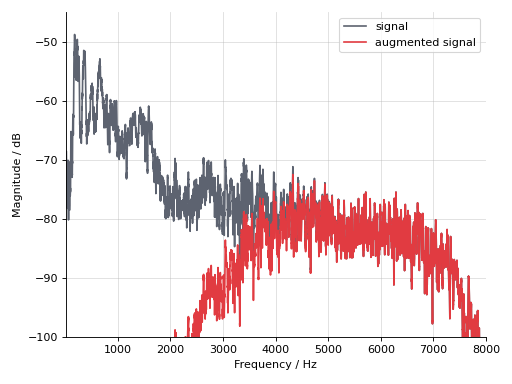
Filter a speech signal with a 4000 Hz, 4th order high pass.
>>> import audb
>>> import audiofile
>>> import audplot
>>> import auglib
>>> transform = auglib.transform.HighPass(4000, order=4)
>>> files = audb.load_media("emodb", "wav/03a01Fa.wav", version="1.4.1")
>>> signal, sampling_rate = audiofile.read(files[0])
>>> augmented_signal = transform(signal, sampling_rate)
>>> audplot.waveform(augmented_signal)

Inspect its magnitude spectrum.
>>> import audmath
>>> import matplotlib.pyplot as plt
>>> import seaborn as sns
>>> sigs = [signal, augmented_signal]
>>> colors = ["#5d6370", "#e13b41"]
>>> for sig, color in zip(sigs, colors):
...     magnitude, f = plt.mlab.magnitude_spectrum(sig, Fs=sampling_rate)
...     # Smooth magnitude
...     magnitude = np.convolve(magnitude, np.ones(14) / 14, mode="same")
...     plt.plot(f, audmath.db(magnitude), color=color)
>>> plt.xlim([10, 8000])
>>> plt.ylim([-100, -45])
>>> plt.ylabel("Magnitude / dB")
>>> plt.xlabel("Frequency / Hz")
>>> plt.legend(["signal", "augmented signal"])
>>> plt.grid(alpha=0.4)
>>> sns.despine()
>>> plt.tight_layout()
The high pass can also filter signals added by other transforms.
>>> transform = auglib.transform.Mix(
...     auglib.transform.WhiteNoiseGaussian(),
...     snr_db=10,
...     transform=auglib.transform.HighPass(7000, order=4),
... )
>>> augmented_signal = transform(signal, sampling_rate)
>>> audplot.waveform(augmented_signal)

__call__()
- HighPass.__call__(signal, sampling_rate=None)
Apply transform to signal.
- Parameters:
signal (
numpy.ndarray) – signal to be transformedsampling_rate (
int) – sampling rate in Hz
- Return type:
- Returns:
augmented signal
- Raises:
ValueError – if the signal shape is not support by chosen transform parameters
ValueError – if
sampling_rateisNone, but the transform requires a sampling rateRuntimeError – if the given sampling rate is incompatible with the transform
arguments
- HighPass.arguments
Returns arguments that are serialized.
- Returns:
Dictionary of arguments and their values.
- Raises:
RuntimeError – if arguments are found that are not assigned to attributes of the same name
Examples
>>> import audobject.testing
>>> o = audobject.testing.TestObject("test", point=(1, 1))
>>> o.arguments
{'name': 'test', 'point': (1, 1)}
borrowed_arguments
- HighPass.borrowed_arguments
Returns borrowed arguments.
- Returns:
Dictionary with borrowed arguments.
from_dict()
- static HighPass.from_dict(d, root=None, **kwargs)
- Return type:
from_yaml()
- static HighPass.from_yaml(path_or_stream, **kwargs)
- Return type:
from_yaml_s()
- static HighPass.from_yaml_s(yaml_string, **kwargs)
- Return type:
id
- HighPass.id
Object identifier.
The ID of an object ID is created from its non-hidden arguments.
- Returns:
object identifier
Examples
>>> class Foo(Object):
...     def __init__(self, bar: str):
...         self.bar = bar
>>> foo1 = Foo("I am unique!")
>>> foo1.id
'893df240-babe-d796-cdf1-c436171b7a96'
>>> foo2 = Foo("I am different!")
>>> foo2.id
'9303f2a5-bfc9-e5ff-0ffa-a9846e2d2190'
>>> foo3 = Foo("I am unique!")
>>> foo1.id == foo3.id
True
is_loaded_from_dict
- HighPass.is_loaded_from_dict
Check if object was loaded from a dictionary.
Returns
Trueif object was initialized from a dictionary, e.g. after loading it from a YAML file.- Returns:
Trueif object was loaded from a dictionary,otherwise
False
resolvers
- HighPass.resolvers
Return resolvers.
- Returns:
Dictionary with resolvers.
short_id
- HighPass.short_id
Short object identifier.
The short ID consists of eight characters and is created from its non-hidden arguments.
- Returns:
short object identifier
Examples
>>> class Foo(Object):
...     def __init__(self, bar: str):
...         self.bar = bar
>>> foo1 = Foo("I am unique!")
>>> foo1.id
'893df240-babe-d796-cdf1-c436171b7a96'
>>> foo1.short_id
'171b7a96'
>>> foo2 = Foo("I am different!")
>>> foo2.short_id
'6e2d2190'
>>> foo3 = Foo("I am unique!")
>>> foo1.short_id == foo3.short_id
True
to_dict()
- HighPass.to_dict(*, include_version=True, flatten=False, root=None)
Converts object to a dictionary.
Includes items from
audobject.Object.arguments. If an argument has a resolver, its value is encoded. Usually, the object can be re-instantiated usingaudobject.Object.from_dict(). However, ifflatten=True, this is not possible.- Parameters:
- Return type:
collections.abc.Mapping[str,typing.Union[bool,datetime.datetime,dict,float,int,list,None,str]]- Returns:
dictionary that represent the object
Examples
>>> import audobject.testing
>>> o = audobject.testing.TestObject("test", point=(1, 1))
>>> o.to_dict(include_version=False)
{'$audobject.core.testing.TestObject': {'name': 'test', 'point': [1, 1]}}
>>> o.to_dict(flatten=True)
{'name': 'test', 'point.0': 1, 'point.1': 1}
to_samples()
to_yaml()
to_yaml_s()
- HighPass.to_yaml_s(*, include_version=True)
Convert object to YAML string.
- Parameters:
include_version (
bool) – add version to class name- Return type:
- Returns:
YAML string
Examples
>>> import audobject.testing
>>> o = audobject.testing.TestObject("test", point=(1, 1))
>>> print(o.to_yaml_s(include_version=False))
$audobject.core.testing.TestObject:
  name: test
  point:
  - 1
  - 1